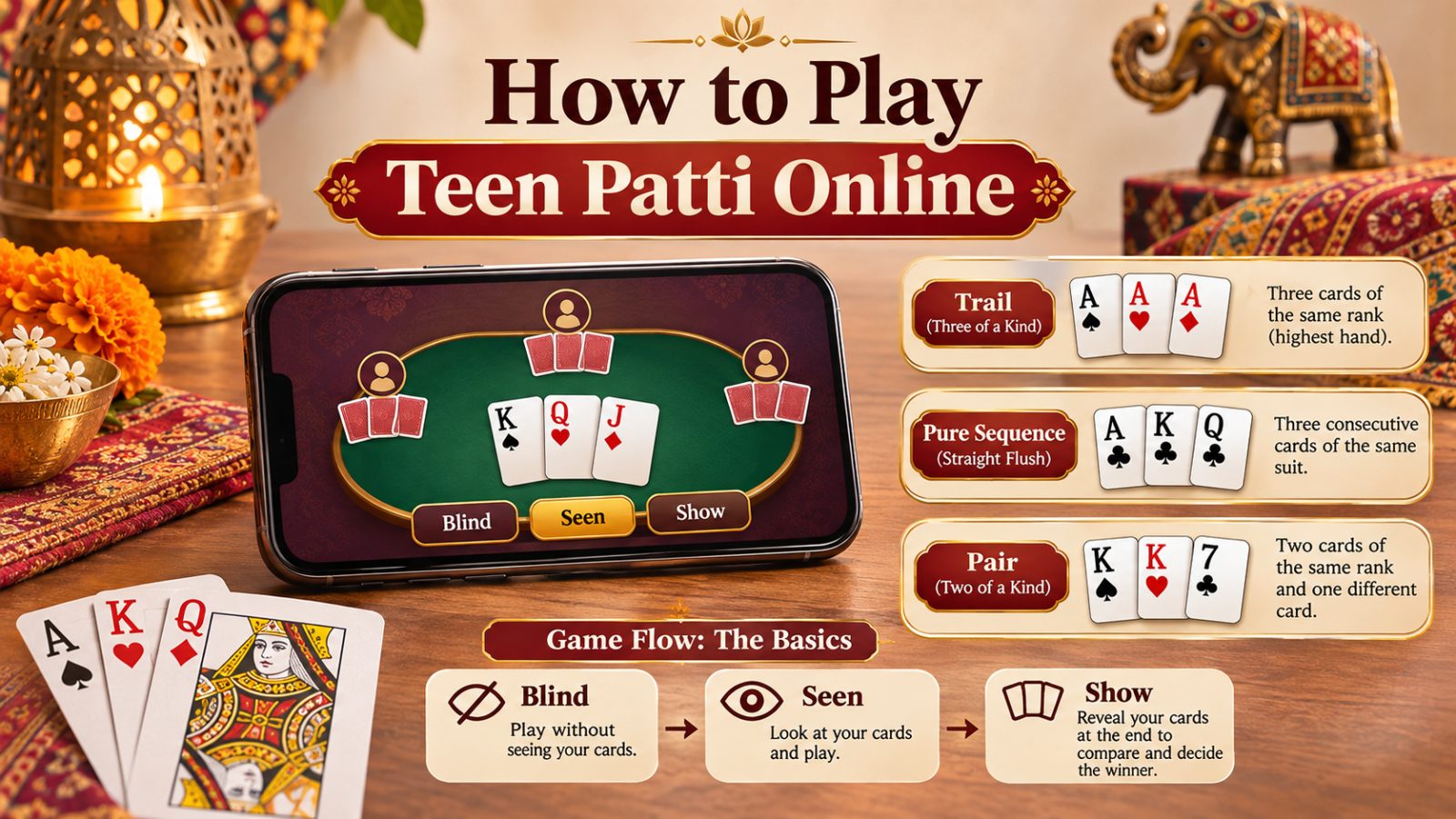
Teen Patti is a popular Indian card game played with three cards. It is easy to learn, but knowing when to continue, fold, or compare hands takes practice. The game uses six hand rankings, and each round can end with a showdown or when all opponents fold. If you want to learn how to play teen patti online, start with the basic rules. Digital versions deal cards automatically, manage turns, and calculate results. You can also find teen patti online in free-play formats, where virtual chips help beginners learn without spending money. This guide explains the rules, hand rankings, blind and seen play, showdowns, and common variations. It also includes a complete round example.
What Is Teen Patti and How Does It Work Online?
Teen Patti means “three cards” in Hindi. It is a traditional Indian game that shares some features with poker. Players receive three cards and compete to hold the strongest hand or remain in the round after everyone else folds.
Basic Teen Patti Game Setup
Teen Patti uses a standard 52-card deck without jokers. A typical game has three to six players, although some versions allow more. Before the cards are dealt, each player contributes an initial amount called the boot. These contributions form the starting pot. The dealer gives three face-down cards to every player. Players then decide whether to remain blind, look at their cards, continue, or fold. The round ends when only one player remains or when the last two players compare their hands in a show.
Traditional Teen Patti vs. Online Teen Patti
Traditional Teen Patti uses physical cards and a dealer who manages the game. Online versions automate dealing, pot calculations, and hand comparisons. Digital tables may also include turn timers, chat functions, and automatic results. Some offer free-play rooms with virtual chips. The main rules remain similar, but contribution limits, show conditions, and special variations can differ between versions.
| Feature | Standard Teen Patti |
| Deck | 52 cards |
| Cards per player | 3 |
| Typical players | 3–6 |
| Main objective | Win the pot |
| Strongest hand | Trail |
| Weakest hand category | High Card |
| Key decisions | Blind, seen, call, raise, fold |
Teen Patti Card Rankings Explained
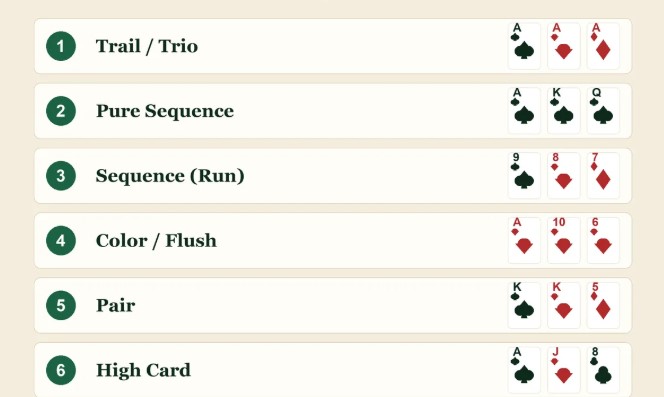
Teen Patti has six main hand categories. Knowing their order is essential because a hand with high individual cards does not always beat a stronger combination.
1. Trail (Three of a Kind)
A Trail contains three cards of the same rank.
Example: A♠ A♥ A♦
Three aces form the strongest Trail. Three kings beat three queens, and three twos form the lowest Trail. A Trail beats every other standard Teen Patti hand.
2. Pure Sequence (Straight Flush)
A Pure Sequence contains three consecutive cards of the same suit.
Example: 7♥ 8♥ 9♥
All three cards must belong to the same suit and follow each other in rank. A Pure Sequence beats an ordinary Sequence, Colour, Pair, or High Card. However, it loses to a Trail. Ace sequences require special attention. Some rules rank A-2-3 above A-K-Q, while others place A-K-Q first. Check the version’s ranking chart before playing.
3. Sequence (Straight)
A Sequence contains three consecutive cards that are not all from the same suit.
Example: 4♠ 5♦ 6♣
The cards must follow the correct numerical order. A Sequence beats a Colour, even when the Colour contains an ace. This is an important difference from some poker formats, where a flush ranks above a straight.
4. Colour (Flush)
A Colour contains three cards of the same suit that do not form a sequence.
Example: A♣ J♣ 8♣
If two players have a Colour, their highest cards are compared first. If those cards match in rank, the second-highest cards are compared. For example, A-K-7 of clubs beats A-Q-10 of hearts because the king outranks the queen. The suits themselves do not normally determine the winner.
5. Pair
A Pair contains two cards of the same rank.
Example: Q♠ Q♥ 5♦
When two players have pairs, the higher pair wins. For example, two queens beat two jacks, regardless of the third card. If both players have the same pair rank, the remaining card decides the result.
6. High Card
A High Card hand contains no pair, sequence, or other stronger combination.
Example: A♠ J♦ 8♣
The highest card determines the winner. If both players have the same highest rank, their second cards are compared, followed by the third if necessary. For example, A-K-8 beats A-Q-J because the king outranks the queen.
Teen Patti Hand Ranking Table
| Rank | Combination | Example | Strength |
| 1 | Trail | A♠ A♥ A♦ | Strongest |
| 2 | Pure Sequence | 7♥ 8♥ 9♥ | Very strong |
| 3 | Sequence | 4♠ 5♦ 6♣ | Strong |
| 4 | Colour | A♣ J♣ 8♣ | Medium |
| 5 | Pair | Q♠ Q♥ 5♦ | Medium |
| 6 | High Card | A♠ J♦ 8♣ | Weakest category |
These rankings apply to standard Teen Patti. Special variants may reverse the order or introduce wild cards.
How to Play Teen Patti Online Step by Step
A standard Teen Patti round follows a simple sequence. Players enter the round, receive three cards, make decisions, and eventually determine a winner. Here is how the process works.
Step 1: Choose a Free-Play Table
A free-play version is useful for beginners because it allows them to learn the controls without risking money. Look for a standard Teen Patti table rather than a special variation. Read the rules before joining, especially the blind and seen contribution requirements. Some practice games use virtual chips. These are game points and may have no monetary value.
Step 2: Understand the Boot Amount
The boot is the initial contribution made by each player before the cards are dealt. Suppose four players each contribute 10 virtual points. The starting pot contains 40 points. The boot amount is not the same as the contribution required during later turns. As the round continues, players may need to contribute additional points to remain active.
Step 3: Receive Your Three Cards
After the initial contributions, the dealer gives each player three cards face down. In an online game, the cards appear on the screen. At this stage, players usually have the option to remain blind or look at their cards. The cards do not change when a player switches from blind to seen. Only the player’s information and available decisions change.
Step 4: Choose Blind or Seen Play
A blind player continues without looking at their cards. A seen player has already viewed their hand. This distinction affects contribution requirements in many traditional rule sets. Blind players generally make smaller required contributions than seen players. However, they must decide without knowing whether they hold a Trail, Pair, or High Card. Once a player looks at their cards, they become seen and normally cannot return to blind status during that round.
Step 5: Call, Raise, or Fold
Players take turns choosing how to proceed.
Call or Chaal: Make the required contribution to remain in the round.
Raise: Increase the contribution within the limits allowed by the table.
Fold or Pack: Leave the round and give up the chance to win the current pot.
For example, a player holding a weak High Card hand may decide to fold rather than continue. A player who folds loses access to the pot, including any points already contributed during that round. However, folding does not affect their ability to participate in the next deal.
Step 6: Understand Side Shows and Showdowns
A side show allows eligible players to compare their cards before the final two-player stage. In a common traditional rule set, this option is available when the players involved have already seen their cards. The request is directed to the previous active player, who may accept or refuse. A final show occurs when only two players remain and the applicable conditions are met. The cards are revealed, and the stronger hand wins. Online versions may use different eligibility rules and automatically display the available actions.
Step 7: Determine the Winner
There are two main ways to win a Teen Patti round. The first is to remain active after every opponent folds. In this case, the winner does not need to reveal the cards. The second is to hold the stronger hand during a showdown. For example, a player with three kings beats someone holding a Pure Sequence because Trail ranks higher. The online interface normally displays the winning hand and updates the virtual point balance automatically.
Teen Patti gameplay flow:
Deal Cards → Blind or Seen → Call, Raise, or Fold → Side Show (if allowed) → Final Show → Winner
Blind vs. Seen in Teen Patti: What Is the Difference?
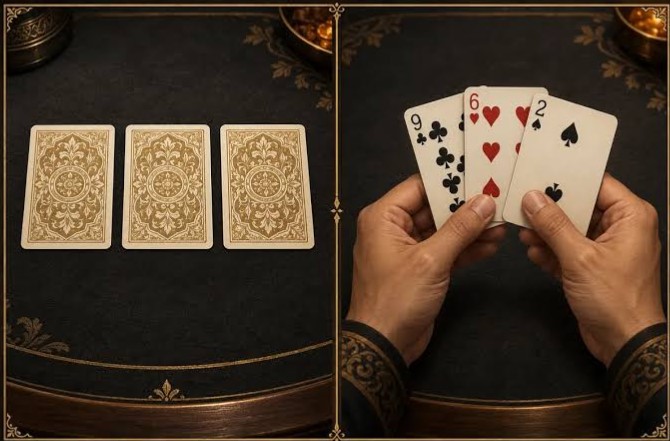
Blind and seen play are among Teen Patti’s most distinctive features. Both players receive three cards, but they make decisions with different levels of information.
Playing Blind
A blind player has not looked at their cards. Under a common traditional rule set, blind players can contribute between one and two times the current stake. For example, if the current stake is 10 virtual points, a blind player may be allowed to contribute 10 or 20 points. The contribution changes the current stake according to the rules of the table. Playing blind does not improve the cards or increase the probability of receiving a strong hand. It simply means making decisions without seeing the cards.
Playing Seen
A seen player knows their three cards. In the same traditional rule set, a seen player must contribute at least twice the current stake and may contribute up to four times that amount. If the current stake is 10 points, the seen player may need to contribute between 20 and 40 points. This creates a trade-off. A seen player has more information but may face higher contribution requirements.
| Feature | Blind | Seen |
| Cards viewed | No | Yes |
| Hand strength known | No | Yes |
| Typical required contribution | Lower | Higher |
| Can switch status | Yes, to seen | Usually cannot return to blind |
| Decision information | Limited | Full knowledge of own cards |
These figures describe one common ruleset. Online games may use different multipliers or contribution limits.
Teen Patti Show and Side Show Rules

A Show and a Side Show both involve comparing cards, but they occur under different conditions.
What Is a Show in Teen Patti?
A Show is the final hand comparison between the last two active players. In a common traditional version, a blind player can request a Show by paying the required contribution. If both remaining players are seen, either may request a Show on their turn. When one player is seen and the other remains blind, the seen player may be unable to demand a Show. The stronger hand wins the pot. If both hands are equal, traditional rules may award the pot to the player who did not request the Show. Other versions use different tie rules.
How Does a Side Show Work?
A Side Show happens while more than two players remain active. In a common version, a seen player can request a comparison with the previous active player after making the required contribution. Both players must be seen. The other player can accept or decline the request. If accepted, the two hands are compared privately. The player with the weaker hand folds. Under traditional rules, equal hands may cause the requesting player to fold. A Side Show does not automatically end the entire round because other players may remain active.
| Feature | Show | Side Show |
| When available | Usually two players remain | More than two remain |
| Participants | Final two players | Two eligible seen players |
| Can be declined | Generally no, once validly requested | Yes |
| Ends the round | Yes | Usually no |
| Main purpose | Determine final winner | Eliminate one player |
Example of a Complete Teen Patti Round
Consider a free-play round involving three players. Each starts by contributing 10 virtual points. The initial pot contains 30 points.
Example: Three Players From Deal to Showdown
The players receive these cards:
Player A: A♠ A♥ 7♦
Player B: K♣ Q♣ J♣
Player C: 9♠ 9♦ 4♥
Player A has a pair of aces. Player B has a Pure Sequence. Player C has a pair of nines. All three players look at their cards and become seen. For this example, the table uses a simplified rule requiring each active player to contribute 20 points per turn, with no raises. Player A contributes 20 points to remain active. Player B also contributes 20 points. Player C decides to fold rather than continue. The pot now contains 70 points. Player A and Player B are the only remaining participants. On Player A’s next turn, a final Show becomes available under this example’s table rules. Both hands are revealed. Player A holds a Pair, while Player B holds a Pure Sequence. Player B wins because a Pure Sequence outranks a Pair. Notice that Player A has two aces, but that does not make the hand stronger than Player B’s consecutive cards of the same suit. The example uses virtual points and simplified contribution rules. Actual Show costs and betting requirements vary between versions.
Common Teen Patti Variations Explained
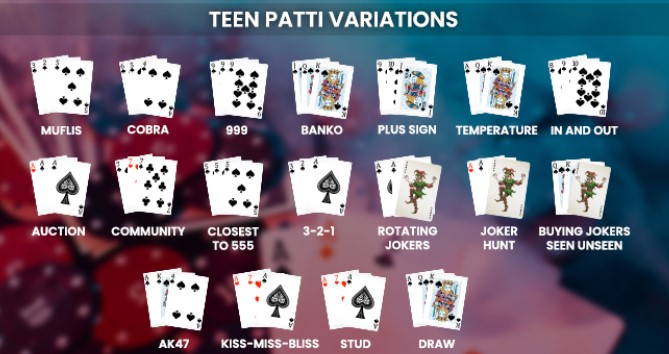
Traditional Teen Patti has several variations. Some change hand rankings, while others introduce jokers or additional cards.
Muflis Teen Patti
Muflis reverses the normal goal of the game. Instead of trying to hold the strongest standard hand, players aim for the weakest hand according to the variant’s ranking system. For example, a High Card hand can become more valuable than a Trail. Players must check the exact comparison rules because some Muflis versions handle ties differently.
Joker Teen Patti
Joker Teen Patti introduces wild cards. Depending on the version, certain cards can substitute for other ranks to complete combinations. For example, a wild card may help form a Trail from two matching cards. The method used to select jokers varies between games.
AK47 Teen Patti
AK47 is a variation in which aces, kings, fours, and sevens commonly act as wild cards. These cards may substitute for other ranks to create stronger combinations. For example, a player holding two queens and an eligible wild card may be able to form three queens. Specific restrictions depend on the version.
Other Popular Variations
Best of Four: Each player receives four cards and selects the strongest three-card combination.
Lowest Joker: A selected low card may act as a joker, according to the variation’s rules.
999: Players aim to form a hand with a value closest to 999 rather than using standard Teen Patti hand rankings.
These variations should not be confused with standard Teen Patti. Always check which rules apply before starting a round.
Teen Patti Tips for Beginners
Teen Patti is easier to understand when players focus on the rules rather than trying to predict the next hand.
Learn the Rankings Before Playing
Start by memorising the six standard hand categories. Pay special attention to the difference between a Sequence and a Colour. Three consecutive cards beat three nonconsecutive cards of the same suit. Also remember that Trail ranks above Pure Sequence. A simple ranking chart can help during the first few practice rounds.
Understand the Available Decisions
Before each turn, check whether you are blind or seen. Understand how much you must contribute to remain active and whether a Side Show is available. Do not confuse raising with improving your hand. A larger contribution does not change the cards you hold. Bluffing can influence other players’ decisions, but it cannot guarantee that they will fold.
Practise Without Real Money
Free-play games allow beginners to become familiar with the controls. Try several rounds using virtual points. Observe how hands are compared and which actions become available as players leave the round. After a showdown, compare the revealed hands with the ranking chart. This is a useful way to identify mistakes without financial risk.
Common Mistakes When Playing Teen Patti Online
Many beginner mistakes come from confusing card rankings or misunderstanding the available actions.
| Common Mistake | Why It Happens | Correct Rule |
| Confusing Sequence and Colour | Both contain three cards | A Sequence needs consecutive ranks |
| Treating every Colour as a Pure Sequence | All cards share one suit | A Pure Sequence also needs consecutive ranks |
| Thinking a Pair beats a Sequence | Two matching cards appear strong | Sequence ranks higher |
| Confusing Show and Side Show | Both compare hands | A Show ends the round; a Side Show usually does not |
| Assuming blind and seen costs are equal | Contribution rules are overlooked | Seen contributions are often higher |
| Misreading ace sequences | Different versions use different rankings | Check the table’s sequence order |
| Using standard rankings in Muflis | Variant rules are ignored | Muflis reverses the normal objective |
Another common mistake is pressing an action before checking the table rules. Online interfaces may use different labels for the same action. For example, folding may appear as “Pack,” while continuing may appear as “Chaal.” Learning these terms helps prevent accidental decisions.
Is Teen Patti Online Based on Skill or Luck?
Teen Patti combines random card distribution with player decisions. The cards are shuffled and dealt without players controlling which combinations they receive. As a result, chance determines the starting strength of every hand. Players can choose whether to continue, raise, or fold. They can also observe opponents’ behaviour and decide how much information to reveal. However, these decisions do not change the cards already dealt. A strong hand can still lose to a stronger combination. A weak hand may win if every opponent folds. No method guarantees a win in every round, and short winning streaks do not predict future results.
Frequently Asked Questions About Playing Teen Patti Online
How Do You Play Teen Patti Online for Beginners?
Teen Patti begins with three cards dealt to each player. Participants can remain blind or view their cards, then decide whether to continue or fold. The round ends when one player remains or the final two players compare their hands.
What Is the Highest Hand in Teen Patti?
Trail is the strongest standard hand category. Three aces form the highest Trail. A Trail beats a Pure Sequence, Sequence, Colour, Pair, and High Card.
What Is the Difference Between Blind and Seen in Teen Patti?
Blind players have not viewed their cards, while seen players know their hands. Blind contributions are often lower, but the player must make decisions without knowing the card combination.
Can You Play Teen Patti Online for Free?
Yes. Some digital Teen Patti games offer free-play modes using virtual chips or points. These formats allow players to practise the rules without depositing money.
What Is the Difference Between a Show and a Side Show?
A Show determines the winner when only two players remain. A Side Show is an earlier comparison between eligible players and normally eliminates one participant without ending the entire round.
Is Teen Patti the Same as Poker?
No. Teen Patti shares features with poker, including hand rankings, betting decisions, and bluffing. However, it normally uses three cards per player and has different hand rankings and betting rules.
Can You Win Teen Patti Every Time?
No. Card distribution depends on chance, and players cannot control the hands their opponents receive. Understanding the rules can improve decision-making, but it cannot guarantee a particular outcome.
Conclusion
Learning how to play Teen Patti online starts with understanding the six hand rankings and the difference between blind and seen play. Players should also know when they can fold, request a Side Show, or compare hands in a final Show. Standard Teen Patti rules provide the foundation for understanding more complex variations. Free-play rounds are a practical way to learn the controls and recognise winning combinations without financial risk.